
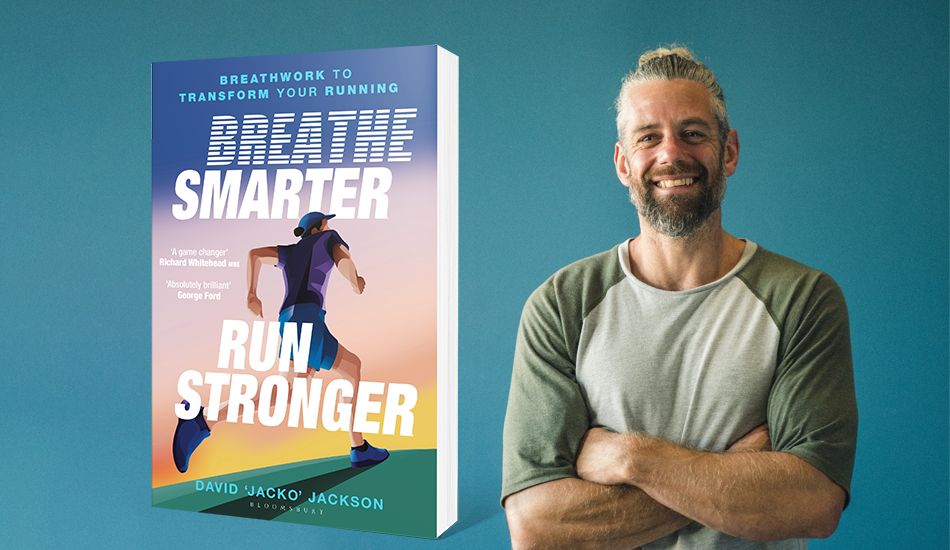
We asked David ‘Jacko’ Jackson, author of Breathe Smarter, Run Stronger, for some example exercises to better breathing.
The cornerstone of better breathing for improved running performance and enjoyment is the ability to control your breathing rate. That’s because your breathing rate is linked to your stress response. The faster you breathe when running the less efficient it is, the higher your perceived exertion and the harder it is to stay relaxed.
Our breathing rate is the easiest thing you can control during running. When our breathing rate is regulated, we are able to relax into our running, which not only influences our running form but also the mind. When we are in control of our breathing rate, we can breathe more efficiently, use and need less oxygen, reduce levels of fatigue and feel less out of breath. With control of our breathing, we can synchronise our breath with our steps which creates all the ingredients to access flow state. Where our thoughts melt away, as the cyclical natural of our breaths links with our foot kissing the floor and we’re hypnotised into a dream state of flow, where our best performances and most enjoyment from running are experienced.
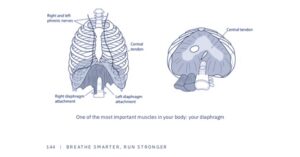
In order to have that control of our breathing we need to be able to call upon the superhero of our breathing story – the diaphragm. We also need to understand the relationship between our one of the most important muscles in your body (your tongue) and your airway – as your tongue is linked to your diaphragm via fascia.
The below exercises are simple ways to activate your diaphragm, and discover the link between the tongue and the diaphragm.
Diaphragm Activation Test (DAT) – page 125-125
This is one of my favourite diaphragm exercises for runners, because it acts as both an assessment of your ability to activate your diaphragm and as a simple isometric activation exercise in itself.
- Take a normal breath in and out of the nose, then pinch your nose.
- Hold your breath – don’t let any air in.
- Then try to initiate a strong inhale while you’re ‘blocking your airway’- in other words, holding your breath and not letting any air in.
If you can activate your diaphragm when you try to breathe in, you’ll feel a pulse or contraction of your diaphragm as though it wants to jump out of your stomach. That’s because when you try to breathe in, the diaphragm ideally should contract and in doing so move down and flatten out. But because you’re holding your breath it can’t move as there is no air coming in, so it contracts isometrically instead. Isometric contractions are great for helping to activate muscles, which is why this is not just an important assessment. It is also a simple exercise you can use to improve your ability to activate your diaphragm and improve the neural firing down your phrenic nerve to the diaphragm from your brain. You need to be able to consciously contract your diaphragm before it’s going to happen unconsciously when running.
Tongue up, breathe back – page 108
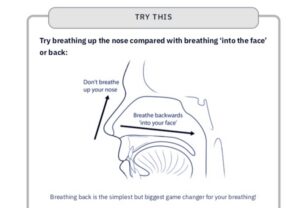
Breathing back is the simplest but biggest game changer for your breathing! Try breathing up the nose compared with breathing ‘into the face’ or back.
Feel the difference for yourself:
- Place one hand on your chest and the other hand on your abdomen so you can feel the changes in the mechanics of where you breathe.
- Firstly, try breathing up your nose, with the tongue at the bottom of your mouth; notice the airflow and how you lift your ribcage and upper chest up vertically.
- Now optimise the alignment of your neck and airway by looking slightly up so that you lift your chin only a small amount, about an inch, to help open the airway. you should feel like your palate is stacked on top of your throat.
- Have the mouth softly closed, jaw relaxed with teeth not touching and place as much of your tongue to the roof of your mouth as you can (front, middle and even back of the tongue).
- Create some light suction to keep the tongue there.
- Now breathe ‘into the face’ through the nose, rather than up the nose.
- Follow the airflow to the back of the throat.
- Compare it with how it felt breathing up your nose – which hand moves more now?
You can read more about nasal breathing and tongue position in the book, Breathe Smarter Run Stronger which is available now.
Listen to our podcast episode with Jacko for a deeper dive into breathing