
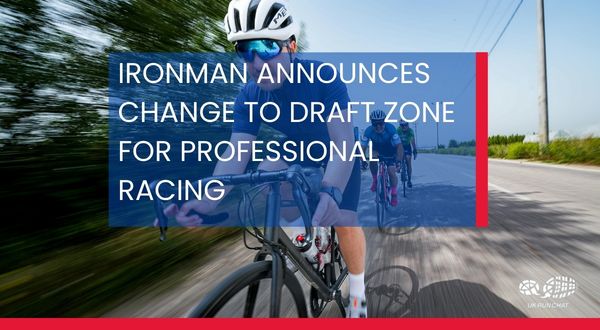
Following the completion of a comprehensive, multiphase draft zone testing initiative that originally began in June 2025, IRONMAN has announced it will increase the professional draft zone distance from 12 to 20 metres, reflecting significant findings generated through scientific testing and research applied to race dynamics. The adjusted professional athlete draft zone distance will be updated in the 2026 IRONMAN Competition Rules, which will be released in February and be effective as of March 1, 2026.
The testing initiative, developed and led in coordination with leading aerodynamics expert Marc Graveline, was designed to produce data insights that could help objectively measure the impact of different draft zone distances on race dynamics, athlete performance, and course density. The results of the testing provided clear and consistent insights demonstrating a meaningful and measurable difference at a longer draft zone distance, supporting a move from the longstanding 12-metre standard to a 20-metre draft zone for professional athletes. Based on differing factors for age-groupers such as racing speeds, the age-group draft zone will remain unchanged at 12 metres.
“When we began our research in mid-2025, our goal was to move beyond opinion and invest in principled and rigorous testing that could provide us with the objective insights needed to make a sound decision for the future of the sport,” said Scott DeRue, CEO of The IRONMAN Group. “The data produced through this process delivered clear insights that a 20-meter draft zone meaningfully impacts race dynamics in the ways that uphold the integrity of our sport. Based on those findings, we are confident this change represents the right next step for the evolution of fair and competitive racing at the professional level.”
The draft zone testing program included baseline aerodynamic testing to establish individual coefficients of aerodynamic drag (CdA), followed by controlled group testing using professional athletes riding at IRONMAN 70.3 race speeds and power outputs. The athletes’ bikes were instrumented to capture power, speed, wind, air density, road inclination, and additional variables, with RaceRanger technology used to precisely maintain designated draft zone distances.
Multiple test runs were conducted at 12, 16, and 20 metres, allowing for direct comparison across distances under consistent conditions. Rider positioning was rotated to account for athlete size and power variability, and the resulting data was analysed to quantify power savings and draft effects at each distance.
Over multiple tests, the results showed that at professional racing speeds, increasing the draft zone distance from 12 metres to 16 metres did not have a material change, however, increasing from 12 metres to 20 metres significantly reduced aerodynamic benefits. As racing speeds have increased over the years, the change to a 20-metre draft zone for professional athletes will help ensure fair competition that is consistent with the intent of non-drafting rules.
For the benefit of the sport, IRONMAN will continue its planned tests of different aerodynamic effects across various race conditions during the 2026 season. They will also continue to collect athlete feedback throughout the season. However, the resulting data and findings from the testing to date provide sufficient and conclusive evidence to make the change to a 20-metre draft zone.
Operational details related to the 20-metre draft zone (e.g., time allowed to pass) will be communicated through the 2026 IRONMAN Competition Rules in advance of implementation to ensure clarity for athletes, officials, and event teams. In addition, as previously announced, IRONMAN will be expanding the use of RaceRanger as a tool across more pro events to support this change and fair competition.
“Our responsibility is to apply what we learn in a way that is fair, consistent, and operationally sound,” DeRue added. “This change reflects our long-term commitment to data and research-based decision making and to continually improve the racing experience for our athletes.”
Prior to 2015, draft zone distances in triathlon varied globally, typically ranging from 7 to 10 metres. With the establishment of its first global competition rules in 2015, IRONMAN adopted a standardised 12-metre draft zone for professional athletes worldwide. Advancements in technology and data-driven insights into racing behaviour have since enabled IRONMAN to more precisely evaluate and evolve those standards.
The move to a 20-metre draft zone for professional athletes represents the next step in that evolution, informed by data, technology, and athlete feedback.
Age-group draft zone distances will remain unchanged at 12 metres. “Compared to professional racing, age-group racing presents a very different set of factors, including racing speeds and course density,” DeRue said. “Based on those realities and informed by historical data, we are confident that the existing 12-metre draft zone continues to best serve the age-group racing experience at this time.”
IRONMAN will continue to monitor age-group racing conditions and leverage technology, officiating, and operational best practices to ensure a fair, safe, and consistent experience for all athletes.