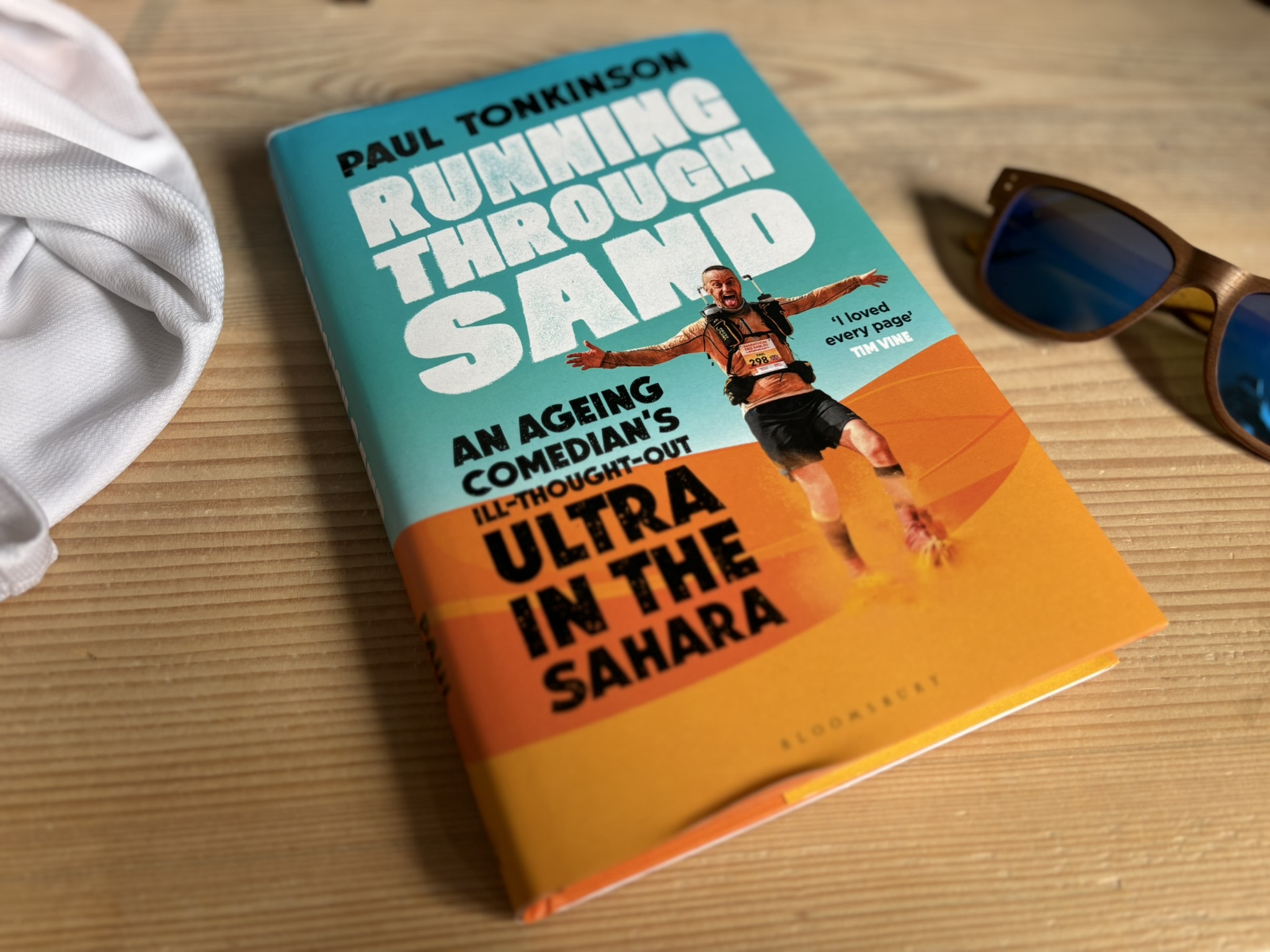
I was expecting Paul Tonkinson’s Running Through Sand to be a very funny account of taking on Marathon des Sables in his fifties. And it is funny in places. But what surprised me most was how philosophical and reflective it is.
A Marathon des Sables book that’s about far more than just the race
The book is split into two parts. The first part of the book is about ageing as a runner, changing as a person, and figuring out whether we’re still capable of hard things when our bodies don’t always want to cooperate anymore.
Paul has a long, frustrating and often chaotic build-up to the race itself, with injuries, DNFs and setbacks making you genuinely wonder whether Paul will ever even get to the MdS start line.
The second half covers the Marathon des Sables itself, in great and gory detail (blisters and toileting realities) and the race sections are brilliant — the endless sand, the heat, the tent life, the long days alone with your thoughts. You really feel immersed in what the event is actually like rather than just reading a race report.
Ageing, self-doubt and changing as a runner
One of the big takeaways from the book for me is that ordinary runners don’t need to be elite to do difficult things. We just need a strong enough reason why.
What I appreciated most was how relatable it all felt as a midlife runner. Paul talks openly about self-doubt, fear, therapy, ego and acceptance. There are moments where he’s talking out loud to himself during races, trying to convince himself to keep going, and I think many runners will recognise themselves in that – I know I did!
Paul reflects honestly on how he’d DNFd races where the motivation wasn’t really there, while Marathon des Sables became something much bigger than a race. It became a way of proving to himself that he could still grow, change and take on something huge later in life.
There’s a line of thought running through the book about comfort and whether modern life makes us too eager to avoid difficulty. Paul repeatedly comes back to the idea that we need hard things, even when our instinct is to seek comfort. That thought has really stayed with me after finishing the book.
More than an ultra-running memoir
This feels less like a race memoir and more like watching someone shed an old skin and become a different version of themselves. The Marathon des Sables becomes part of that transformation, not just as a race to finish, but as the thing that forces change to happen.
One scene that is particularly memorable is Paul alone during the long day in the desert, talking to a butterfly while battling his own thoughts and demons. Moments like that are what elevate the book beyond a simple endurance story about running across a desert.
As someone currently navigating my own struggles with running and motivation in midlife, I found a lot of the book reassuring. Paul articulated perfectly many of my own thoughts around running and ageing. Lately I’ve even found myself questioning whether to quit running altogether because it sometimes feels so much harder than it used to. But this book reminded me that the answer isn’t to stop challenging ourselves, it’s just to pick the right challenge for where we are right now.
This book made me feel less alone in the doubts and shifting relationship I’m experiencing with running as I get older. I finished it feeling surprisingly positive: we can still do hard things, even when we don’t fully believe we can. And we absolutely should be pushing ourselves to do them.
I loved Paul’s reflection after the race that he now wants to run in a way that allows him to run again tomorrow. Maybe getting older simply changes what you want and need from running.
I closed the book feeling more optimistic about my own running. Ageing as a runner is not easy, but Paul reminds us that we’re capable of far more than we give ourselves credit for.
If you’d like to hear more of Paul Tonkinson’s musings on the Marathon Des Sables, listen to our interview with him on the UKRunChat podcast.