
Runners are no longer just fundraising for a cause, they’re running straight through it.
It’s a trend giving everyday people the chance to move through somewhere that matters – not just somewhere scenic – all while having the opportunity to witness the impact of their fundraising efforts first-hand.
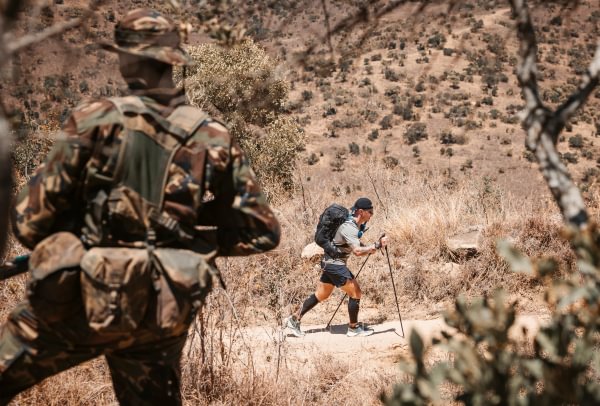
The ForRangers Ultra is a perfect example of this: an ultramarathon where runners meet the very rangers they’re raising money for, and have the unique chance not only to visit, but run through the landscapes that money helps protect.
Sadly, more than 2,000 rangers have lost their lives protecting Africa’s wildlife and habitats in recent decades. Founded in 2015, the ForRangers initiative, in collaboration with Save the Rhino International, aims to change this by improving the welfare of rangers across Africa. Through its efforts, ForRangers raises funds and awareness to provide equipment and welfare support to rangers protecting threatened species, conserving ecosystems, and tackling poaching on the ground.
At the very heart of this initiative’s fundraising work is the Ultra, founded in 2018 in partnership with Save the Rhino and Beyond the Ultimate. This 230km, five-day ultramarathon takes runners on an epic journey through the Kenyan wilderness – a landscape few people ever get to visit, let alone on foot.
The route takes runners through the very field programmes Save the Rhino supports – four different conservancies (land protected for the purposes of wildlife conservation) – each with its own unique terrain, from verdant grasslands to dense forest. This is Big Five territory: teeming with rhino, elephant, lion, leopard and Cape buffalo.
Every evening, after a day’s running, campfire talks from specialists at each conservancy cover a different wildlife conservation topic – participants may even be lucky enough to fall asleep to the sound of lions roaring. It truly is the race of a lifetime, and a rare chance to step into habitats most people will never see.
Jackie Head, who ran the Ultra in 2026, said: “The moment I encountered a rhino on foot, the true urgency of the fundraising mission became vividly real. Sharing the trail with the extraordinary rangers who serve as the thin line against poaching was both deeply humbling and fiercely motivating. You realise very quickly that this isn’t just an ultra marathon; it’s an active partnership to preserve one of the most magnificent ecosystems on Earth.”
Born out of the wildlife ranger crisis, the Ultra has raised £855,751 to date. Since 2017, funds have contributed towards medical and first-aid kits, rations, boots and field equipment such as mobile phones and cooking stoves. Beyond the day-to-day essentials, the Ultra also champions bigger projects such as ranger housing to strengthen rhino monitoring and law enforcement, financial literacy training, and sessions on how to manage venomous snakes encountered in the field.
The majority of people who raise money for a good cause never get to meet the people it supports. On the Ultra, runners do.
Pete Malovany, star fundraiser and winner of the ForRangers Ultra Victor Ledorum award had this to say: “To see first-hand where the money goes, and to hear directly how that support has improved the rangers’ welfare and their ability to protect some of the world’s most important wildlife, was extremely powerful. When you’re exhausted, in pain and wondering how you’ll get through ‘just another marathon’, knowing the people and purpose behind every kilometre changes everything. I came away with huge respect for the rangers and a real sense of privilege that our running could play even a small part in supporting the work they do every day.”
In 2026 alone, grants awarded by Save the Rhino have included £26,373 to cover annual life insurance for 1,807 rangers across Africa, £15,080 to establish a year-round gym on the Borana Conservancy, and £14,884 for equipment such as tents and camera-traps along key wildlife corridors within the Ol Pejeta Conservancy.
That’s just a handful of what the Ultra has made possible this year – all of it comes back to one key point: rangers can only safeguard rhinos and the landscapes they inhabit if they are well-equipped and trained.
In 2027, the ForRangers Ultra will mark its tenth anniversary. Over half the spots for next year’s challenge are already gone.
Sign up today to support rhino conservation and ranger welfare.