
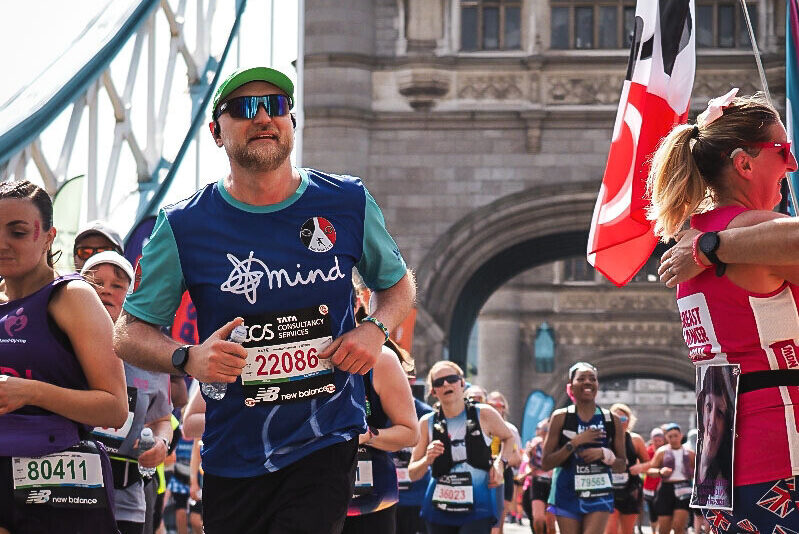
When we first spoke to Tim Goule on the UKRunChat podcast two years ago, running was an important part of how he managed his mental health. He enjoyed running along the canals near home, fitting his miles around work and family life. Having completed a half marathon, he had another ambition in mind: to run the London Marathon.
When Tim returned to the UKRunChat podcast in 2026, he had achieved that goal. His first marathon had taken him through months of training, early starts, difficult long runs and the challenge of balancing a major personal commitment with family life. The experience also gave him a fresh perspective on why he runs, and what he wants from it.
Finally getting a place at the London Marathon
Tim received his London Marathon ballot email in July 2025, around a year after our first conversation.
“It must have been fate because 12 months after our conversation, I received that email.”
Securing a place meant turning an ambition into a practical commitment. A marathon would demand more time and preparation than the half marathon he had already completed, but Tim was determined to make it to the finish.
“I was adamant I was getting over that line one way or another.”
Running was already a bit part of Tim’s routine, but training towards a specific goal gave him a new focus. The challenge was no longer simply to get out for a run; it was to prepare for 26.2 miles while making sure training remained compatible with the rest of his life.
Fitting marathon training around family life
With work and two children to consider, Tim needed a training plan that worked in the real world. He used the guidance provided by the London Marathon and adapted a plan around his own schedule, using AI to help organise his sessions.
Having the plan visible helped him keep track of his progress and what lay ahead.
“I had one plan on my work computer that I would go into every couple of the days and just see what I’d done last week, and what I had coming up this week. And I had one in the kitchen.”
He also spoke to his family about the commitment involved, particularly as the long runs began to take up more of the weekend.
“I kind of made the point to my wife and my kids that on a weekend, I’m going to be doing long runs and they’re going to be getting longer.”
Flexibility was important. Tim tried to fit his longer sessions around family plans, rather than expecting every weekend to follow the same pattern. That approach was tested during a family trip to Disneyland Paris, where he got up at around 5am to run before the day began.
He completed around 90% of his modified plan, generally running four times a week before increasing his training slightly as race day approached.
His family became part of the experience, too. His son could follow his progress on an app and sometimes called him during long runs. One particularly memorable moment came when his son wanted to join him for a run along one of his favourite canal routes.
“Can you go at your pace now, Dad, so I can see if I can keep up? and then can you run at my pace.”
They spent the run walking, chatting and enjoying time together. For Tim, it was also a reminder of running with his own dad when he was a child, a connection that gave the experience a significance beyond marathon preparation.
The reality of training for a first marathon
Moving from half marathon to marathon distance was a substantial step, and Tim had moments when the scale of the challenge felt daunting. He admits, “It was scary.”
As the weeks passed, however, distances that had once seemed intimidating became part of his routine. He was running beyond half marathon distance on ordinary training weekends and discovering what his body could manage.
“I was just amazed that my body was doing that every week.”
Progress was not always straightforward. His longest training run was 21 miles, and it proved to be one of the toughest sessions mentally. He struggled to find his rhythm and came away questioning how he would manage the remaining distance on race day.
“I think it was more mental.I just couldn’t get my engine going.”
It was a difficult experience, particularly with the marathon still ahead of him. Yet it also highlighted an important distinction: training and racing can feel very different. The long runs are essential preparation, but they do not always capture the atmosphere, support and sense of occasion that can carry a runner through a race.
For Tim, the contrast was striking.
“The training is the worst part. The London Marathon was the celebration.”
Running the London Marathon: the crowds, the wall and the finish line
Tim travelled to London with his family, visited the expo and took in the atmosphere before race day. On the morning of the marathon, he found himself chatting to other runners on the Tube and joining the crowds making their way to the start. Tim describes the pre-race feeling as a buzz: “You could just feel it, the atmosphere”.
Once underway, he drew on a playlist featuring songs contributed by friends, as well as the landmarks and crowds along the route. Tower Bridge stood out, not just for the setting but for the scale of the support from spectators.
“How many people are cheering on a bridge non-stop, and they don’t know you from Adam!”
The experience was not effortless, though. Tim felt he hit the wall earlier than expected, and the miles became increasingly difficult. At points, the physical challenge made it hard to appreciate the occasion around him.
“I felt like I wasn’t enjoying it for that moment. It was hard, it was gruelling.”
He kept working his way towards the finish, drawing encouragement from the crowds and the knowledge that he was getting closer. The stretch along the Embankment, with Big Ben in view, was another landmark moment.
Then he spotted his brother, followed by his wife and children. “I saw my wife and kids and absolutely broke down.”
Crossing the finish line marked the end of months of work, but Tim’s reflections went beyond the result or the time on his watch. The difficult sessions, the early starts and the moments of doubt had all contributed to getting him there.
“The whole thing was amazing. It was hard. And I wouldn’t change any of it, I don’t think, because it’s what got me over that line.”
He was also glad he had waited for London rather than choosing another marathon simply to complete the distance.
After the marathon: post-race blues and a different perspective
After months of working towards one clear objective, finishing the marathon left Tim with a brief period of uncertainty about what to focus on next.
“The blues itself lasted a couple of weeks where it was hard to not focus on something.”
There were practical benefits to being back to normal though. Without the long runs taking over his weekends, he could spend more time with his family and return to shorter runs before or after work. He reflects: “It was nice to get my weekends back.”
More importantly, running could once again be something he did for its own sake. The mental health and fitness benefits that had drawn him to running in the first place were still there, without the pressure of a major event dictating every session.
“When I go out now and do a run I’m always looking to get the benefits from it that I’ve always got, like mental health and fitness.”
Tim remains interested in taking on another challenge, but he is also considering returning to half marathons rather than immediately committing to another full marathon. For now, he has the freedom to decide what he wants from running next.
“It’s nice to enjoy it for what it is.”
Tim’s advice to runners: don’t get too caught up in times
Looking back at the runner he was two years ago, Tim’s advice is less about chasing a bigger goal than about keeping running part of your life: “Get out when you can.”
He recognises how easy it is to become preoccupied with improving times and measuring progress. Completing the London Marathon gave him a different perspective on what matters most: “I love my watch. I love seeing my time, but it’s not the most important thing.”
Tim’s journey from half marathon to his first marathon shows what can happen when a goal is built around the realities of everyday life. Consistent training helped him discover what he was capable of, while the experience itself reminded him that running is about more than a finish time.
A big goal can provide direction and motivation, but it doesn’t have to become the only reason to run. Sometimes, the most valuable outcome is finding your way back to the simple pleasure of getting out the door.
You can follow Tim on Instagram at @run_with_fonz and listen to his conversation with Michelle on the UKRunChat podcast.