Britain’s triathlon season is around the corner, and most athletes are already over-training the one leg they can’t afford to get wrong, the run.
More than 120,000 people raced triathlons in Great Britain last year, according to the Triathlon Industry Alliance’s 2025 Participation Analysis Report. For many, the run leg is where their race falls apart, not because of fitness, but because of everything that came before it.
Former GB distance runner and ex-triathlete Matt Bond at Ronhill says the issue isn’t motivation. It’s over-training and under-recovering. Having competed at an elite level and returned to endurance sport in his 40s, Bond sees the same pattern among club runners, Parkrun regulars, and gym-goers: stacking hard sessions, skipping rest, and unknowingly sabotaging their fitness.
Matt explains:
- Why fitness gains come from recovery, not effort
- How “no days off” culture leads to burnout
- Why training needs to change as we get older
Although informed by endurance sport, the insights apply to anyone trying to stay fit and healthy long-term.
I’m a former triathlete: here’s why the run is the hardest part and how to approach it
Triathletes of all abilities and experience levels can discover that the run portion of the event is what makes or breaks their overall performance. After all, this is where the competition is won or lost – whether your goal is to finish near the front of the field, position well in your age-group, get one up on your regular adversary/nemesis, or simply to get to the finish line.
When you arrive at the run portion of a triathlon, you have already expended a significant amount of energy on the previous two disciplines, so it’s possible for even experienced runners turned triathletes to come unstuck here.
The positive news is that with the correct preparation and training, you can not only survive the run but finish strong and show those who may not necessarily have adopted the correct approach a clean pair of heels.
Here are my top six tips for the final portion of your triathlon:
Pacing
Even if training has gone perfectly and you’ve applied all the applicable advice here, it would be highly unusual for you to hit the run with your legs feeling as fresh as they would at the start of a regular running event.
The key here is to start the run section no faster (or possibly slightly slower) than the pace you’ve targeted yourself to run for the entire distance. It’s important to get a feel for pace without relying on a GPS watch, as the pace displayed on that device (particularly if in min/km rather than min/mile) could be significantly out.
Focus on your breathing and give yourself time to hit your stride. Don’t be tempted to follow the move of any ‘have a go heroes’ sprinting off at the start of the run portion. If you trust in your training and stick to your plan, the chances are you’ll be seeing them again well before the finish line.
Consistency
Use the time you have available for your run training wisely. Don’t overlook your key sessions that will help move you onto that next level or enable you to reach your goal, but don’t neglect the easy and steady runs either.
If running isn’t your background/strength, you may find it beneficial to join your local running/athletics club. There’s nothing to be afraid of – it’s a great way to meet new people, and the training and races you may end up attending will give you a huge amount of confidence for your triathlon events. Most clubs have groups that cater for all levels of runners.
While the quality of your run training is important, volume should also be monitored. A good rule of thumb for keeping your weekly mileage in check is to never increase by more than 10% than the week before. Also, every three to four weeks (three weeks is best for triathletes over 40), decrease your mileage by approximately a third.
It’s often a good idea at the end of a mini taper week, such as this, to enter some sort of event. If no triathlon events are planned, then this could be a run race or even a Parkrun to gauge where your current fitness is.
The bike-to-run transition
The best way to prepare the body for the feeling of getting straight into running immediately after the bike is to incorporate it into your training. You may already be familiar with ‘brick sessions’, which involve replicating the final two portions of a triathlon immediately after one another.
The volume and intensity of these ‘brick sessions’ will vary depending on your ability and experience level. For beginners, a 30 to 60 minute bike ride followed by a 10 to 15 minute run would be a good place to start, whereas more advanced competitors can progress from here in both volume and intensity. If you can, aim for at least one brick session per week in the eight to ten-week lead-up before your race.
Research shows that practising brick workouts increased knee adaptability during the cycling-into-running transition, supporting smoother mechanics.
Strength training and stretching
Whilst strength training can complement run training, it could be argued it’s even more important for bike training, which in turn will assist you in the run element of a triathlon. The better you feel off the bike, the better you will feel throughout the run.
Strength training has even more importance for triathletes over the age of 40 – this is because, as we get older, muscles weaken/deteriorate at a faster rate than in our younger years. There is far too much detail surrounding the aspects of strength training and stretching to convey in full here, and some further reading on this may be necessary to develop properly.
There are numerous good sources on this area, including those by Joe Friel author of both ‘The Triathlete’s Training Bible’ and ‘The Cyclist’s Training Bible’.
In the latter, Joe explains the four stages of the strength training program: Anatomical Adaptation (focussing on developing the body’s ability to handle training stress), Max Transition (preparing the athlete for heavier lifting to come), Max Strength (builds maximal strength) and Strength Maintenance (fewer sessions per week but still incorporating some heavy lifting with low reps).
The anatomical adaptation phase begins at the end of the off-season, usually during the winter months, and involves lighter weights but a higher number of reps than in the other phases. Ideally, there should be more gym sessions at this time of year compared to during the strength maintenance phase, when training becomes more specific and visiting the gym should only be necessary once per week.
Fuel
Parallels can be drawn between the human body and racing cars. It doesn’t matter how fast your vehicle can go – if you don’t put the right type or the right amount of fuel, it simply won’t perform the way you want it to.
In a triathlon, the easiest times to fuel and hydrate are in the lead-up to the event and on the bike portion. If done correctly, this will provide the best possible platform for you to start the run portion of the triathlon.
Your hydration strategy before an event shouldn’t differ too much from the strategy you employ for day-to-day training. As a guide, it’s best if possible to get most (if not all) of your hydration done before 7:30 pm to reduce any interruptions to your nighttime sleep pattern, which could negatively impact recovery.
In the morning of the race, sip steadily, making sure you arrive on the start line feeling hydrated but not uncomfortable. When you’re cycling, drink little and often. Your fueling and hydration strategy will vary depending on the weather and length of your competition – for instance, you will need to take on significantly more fluid and carbohydrates for an Ironman event than you would for a sprint distance event. For the former two bottle cages would be essential, whereas for the latter, only one may be required.
The same applies to the run portion of the event. For the marathon section of an Ironman, you will find you need to take on fluid and fuel at numerous points throughout the course of the run; however, in the run portion of a sprint or Olympic distance triathlon in mild conditions, some triathletes may be able to cover the 5-10k at their target pace without onboarding any fluid or fuel at all.
Fuelling and hydration strategies not only vary due to distances of the event or weather conditions but also from individual to individual. What works for some may not work for others, and it is important to test your fuelling and hydration strategy in training in the lead up to your event.
It’s worthwhile taking on gels or more solid forms of fuel, such as chews, during the exercise you are intending to take during the event – be it the bike, the run or both.
Recovery
Recovery is a key aspect of training often neglected, particularly by highly motivated athletes. A common misconception is that it is the training sessions themselves which increase fitness, whereas it is, in fact, the recovery from these sessions and races that brings about increased fitness levels. We’ve already mentioned the importance of sleep as an aspect of recovery, but spacing out harder sessions is also important to give your body time to repair.
After more intense run sessions, it’s particularly important to incorporate a warm-down (as well as a warm-up) to enable yourself to gradually lower your heart rate. It’s also important at this time to rehydrate and take on a good mix of carbohydrates and protein, ideally within 20 minutes. A protein shake can be a convenient and versatile option immediately after training. As with strength training, stretching is important after these key sessions/workouts.
When recovering and looking after your body, don’t forget those parts of your body closest to the ground that have taken all that impact – your feet! Your feet are far more likely to forgive you and prepare themselves better for the next session if you reward them by replacing close-fitting footwear with a recovery slider.
Thanks for reading. I would wish you good luck for your event, but with the correct preparation, luck will have very little to do with it!
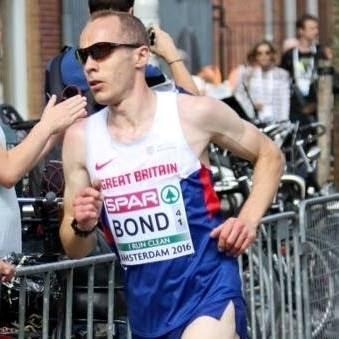
Former Triathlete/Duathlete turned GB Distance Runner, Matt retired from competitive athletics in 2017 after the birth of his first daughter. This year, after a long hiatus, he returned to aspects of endurance sports with a top ten finish at the Isle of Man Gran Fondo. He helped set a WR for the fastest team to push a wheelchair user at the Great North Run (78:02), raising money for the Matt Hampson Foundation and Gympossible – a specialist gym set up by his friend and former teammate Drew Graham. PBs: 5k: 13:51, 10k: 29:08, Half Marathon: 64:29, Marathon: 2:15:32