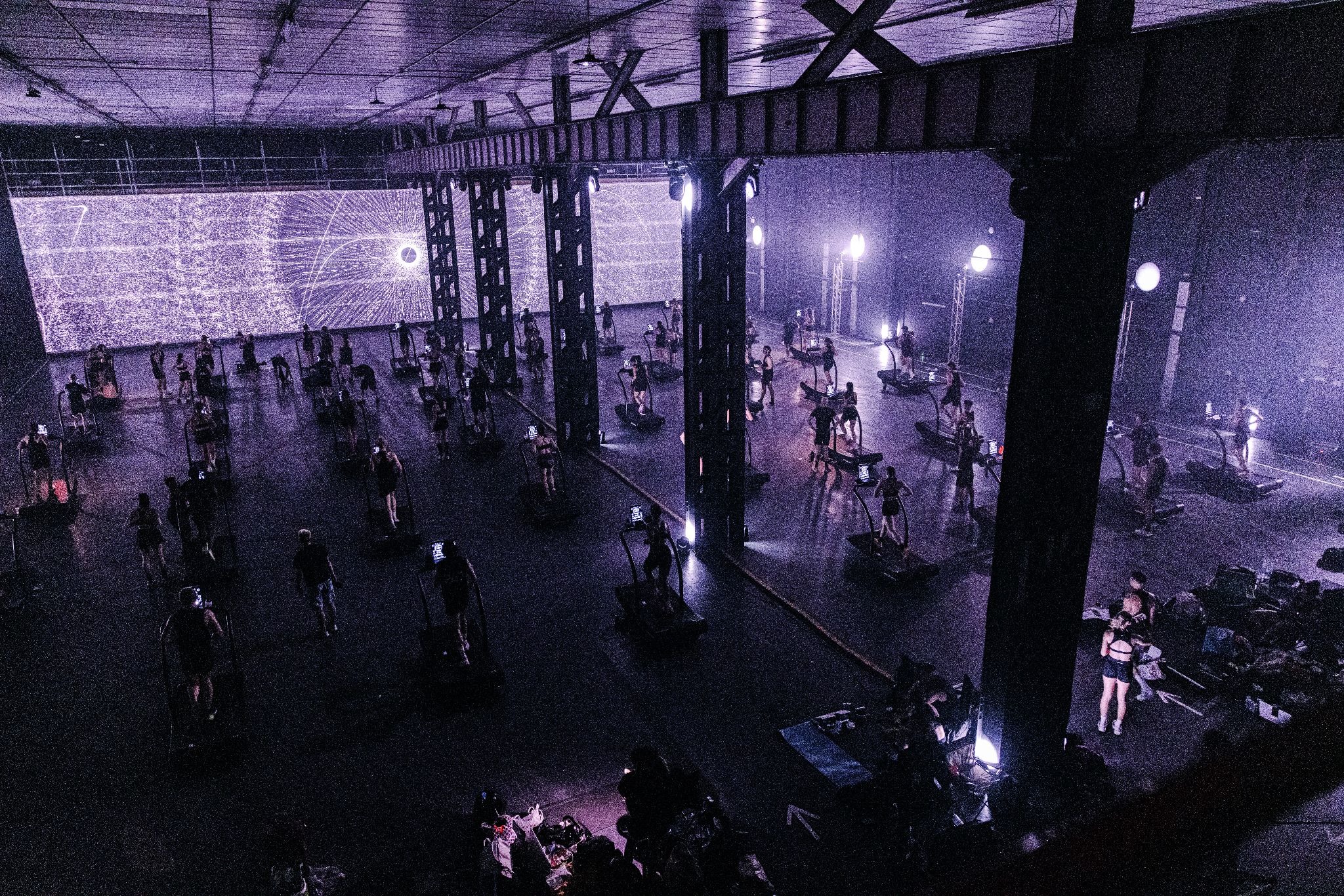
Arc Project, the unsanctioned ultramarathon series that exists to show ordinary people the limits they were taught are not the limits they actually have, has completed its most ambitious project to date: a 24-hour treadmill ultramarathon relay in a decommissioned World War II tank factory in North London. The format had never been attempted anywhere in the world.
160 runners took to 40 treadmills at 10am on Saturday 30 May, competing in teams of four until 10am Sunday. Every team must be two women and two men. This is a hard rule of entry, not a target. Every single team was still running when the clock stopped.
Collectively, the 40 teams covered 9,097.3km over 24 hours. Nearly the distance from the UK to Japan. Without leaving a single room.
Each of the 24 hours was a distinct experience of light, sound and temperature, curated by a London DJ. Organisers describe the arc across the race as simulating the psychological journey of a psychedelic trip, without the illegal stimulus.
The winning team
The winning team was Salty Boys AC, sponsored by SportShoes, who covered a cumulative distance of 286.08km across the 24 hours. The team comprised Rob Ellis (M, 33), team captain and founder of Salty Boys AC; Katie Heron (F, 34); Charlotte Davies (F, 35); and Konstantin Kissimov (M, 24).
Salty Boys AC are veterans and winners of The Speed Project, one of the world’s most celebrated unsanctioned ultramarathon relays. On AP4, team captain Rob Ellis said: “Hands down the hardest thing we’ve ever done. Running from nowhere to nowhere takes a mental toll that’s hard to match. AP is just you, vs the treadmill speed gauge, surrounded by other people fighting the same battle. The intensity was on another level.”
Tackling the gender gap in ultra running
The numbers on women in ultra running make difficult reading. Female participation in ultra distances has fallen by roughly 10% since 2020, the steepest decline of any running distance. Men make up 76% of 100-mile fields globally. Arc Project mandates a 50/50 gender split at every event as a hard rule of entry. AP4 became, to its organisers’ knowledge, the most prominent gender-balanced ultramarathon ever staged in the United Kingdom.
Sasha Kojjio
Sasha Kojjio is a Barcelona-based digital artist and light-code practitioner. Arc Project approached Sasha for the collaboration, and following initial calls, he was inspired by a cool creative concept he saw come out of Nike in Portland and wanted to take it a step further in the form of light code.
Sasha’s work sits at the intersection of technology, movement and spatial storytelling – using custom-coded visual systems to transform physical environments into living, reactive canvases. Serving as Artistic Director on AP4 – The Treadmill Factory, Sasha built a 24-hour simulation of coded visuals that appear on the 30 x 9 metre screen at the front of the venue. Every visual that catches the eye of participants and spectators throughout the event was hand coded by him. The centrepiece is the iconic Pegasus horse, an animated sequence designed to encourage participants to push harder and feel more alive.
In Sasha’s own words: “The Pegasus has always represented something primal about movement and endurance. The opportunity to bring this to life in a way never seen before is really special – I coded the horses to feel alive on that screen, and to push participants up a gear. This is exactly the kind of project I live to be part of.”
What came before
AP4 follows AP3, Arc Project’s 600km relay across the entire London Underground network, contested by 150 runners on 29 November 2025, the busiest shopping day of the year. The project generated over 3 million social impressions and received a standalone feature in the Evening Standard [LINK].
James Taker, Co-Founder of Arc Project, said: “We believe that everyone is capable of doing incredible things. They just need an opportunity and people that believe in them. We do both of those things. AP5 here we come”.
Sonni Dyson, Co-Founder of Arc Project, said: “Ultra running has a problem when it comes to female representation, and the industry has spent years talking about it. We decided to try and address it. Every Arc Project has a mandatory 50/50 split. I’m proud of the change we advocate for.”